The Long Quiet
If you came here for productivity tips or hot takes, I'm sorry; this isn't that kind of place. This is a vibe space.
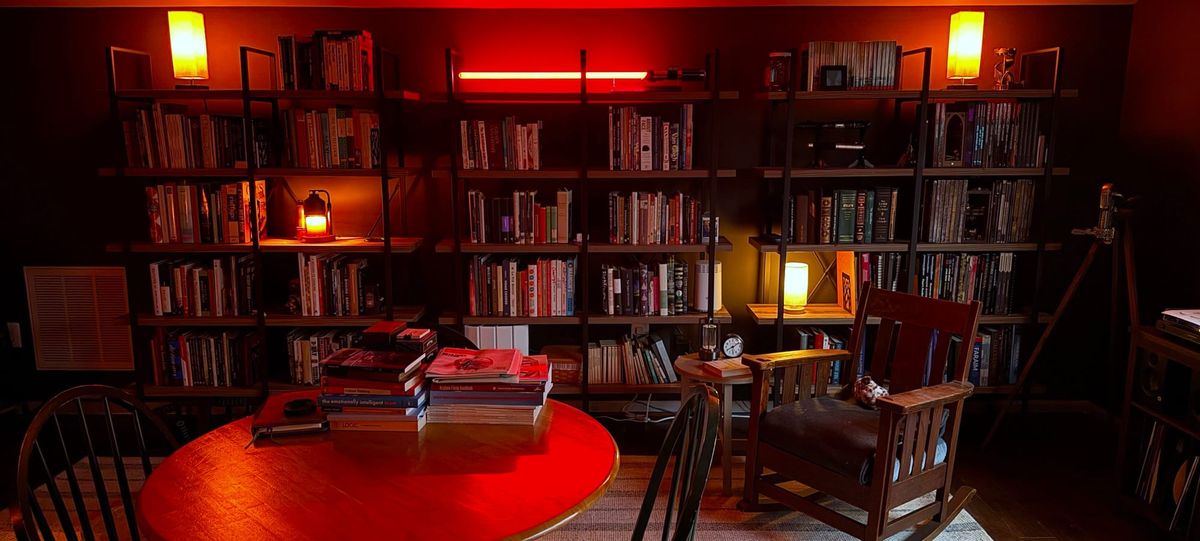
There is a kind of morning I have come to love. The house is still asleep. The coffee has gone cold and I drink it anyway. On the desk there is a paperback with a cracked spine, face-down where I stopped, and on the screen a small ship is drifting toward a star nobody has ever named.
That is most of it, really. Books, solitude, and a spaceship. If you came here for productivity tips or hot takes, I'm sorry; this isn't that kind of place. This is the kind of virtual space people kept before everything became a feed: a room with a low lamp burning, a few shelves, and somebody who writes when he is moved to do so.
This is a vibe space.
I want to explain the some things, because I've slowly realized they are one thing: the life I have cultivated for myself, but feel that others out there might enjoy it too.
The books. I mostly read old ones. The Hávamál, which is essentially a Norse grandfather telling you not to drink too much at the feast and to keep an eye on the door. Marcus Aurelius, writing notes to himself in a tent on the frontier, never meaning for anyone else to see them. Musashi, near the end of his life, setting down a short list of precepts for walking the road alone. These aren't books you finish. They are books you come back to, the way you come back to a window.
The solitude. I want to be careful here, because solitude gets confused with loneliness, and they are not the same animal. Loneliness is a lack. Solitude is a practice. I have loved ones, friends, and a job full of meetings, and I would not trade any of it. But a man who never sits alone with his own mind eventually stops knowing what's in there. The quiet hour is where I go to find out.
The game. Elite Dangerous is a space simulator built on a one-to-one model of the Milky Way: something like four hundred billion star systems, the overwhelming majority of which no human being has ever visited. You can trade, fight, mine, haul cargo for strangers. Or you can do what I mostly do, which is point the ship toward the galactic core and go. Jump. Scoop fuel from a star. Scan the system. Jump again. Hours of it. Now and then a ringed giant worth stopping for, or a water world glowing blue against the black. Mostly just the next star.
People who don't play it find this baffling. So nothing happens? It's just a grind? Correct. Nothing happens, gloriously, for a very long time.
Here is what I've noticed. A long exploration run feels like meditation. Same attention, same posture, same slow settling of the mind. The drive spools up, the countdown runs, the tunnel of witch-space opens, and for a few seconds there is nothing to do but wait. A thought gets room to finish itself. Somewhere between one star and the next, a line from the Meditations I read that morning finally makes sense, or a problem I've been circling at work quietly comes apart in my hands.
The old contemplatives went to the desert for this. The monks built cells. Musashi went to a cave. I have a personal sanctuary: a chair, a headset, and a few hundred light-years of nothing. I don't think the difference matters as much as you'd expect.
There's a risk in all of this: solitude can curdle into hiding. A hobby can become an escape hatch. A shelf of Stoics can become a costume. I don't claim to have the balance right. That's partly why I'm writing. To actively make sense of it all.
So this blog will be about that life: the books I keep returning to, the hours alone that make the rest of the hours better, and a game that turns out to be a surprisingly good place to think. Some posts will be about Odin. Some will be about fuel management. Most will be about both.
Pour something warm. Pull up a chair. The kettle's on, and the black is very big.
o7, Commander.
